 Jacksonville Terrazzo Restoration
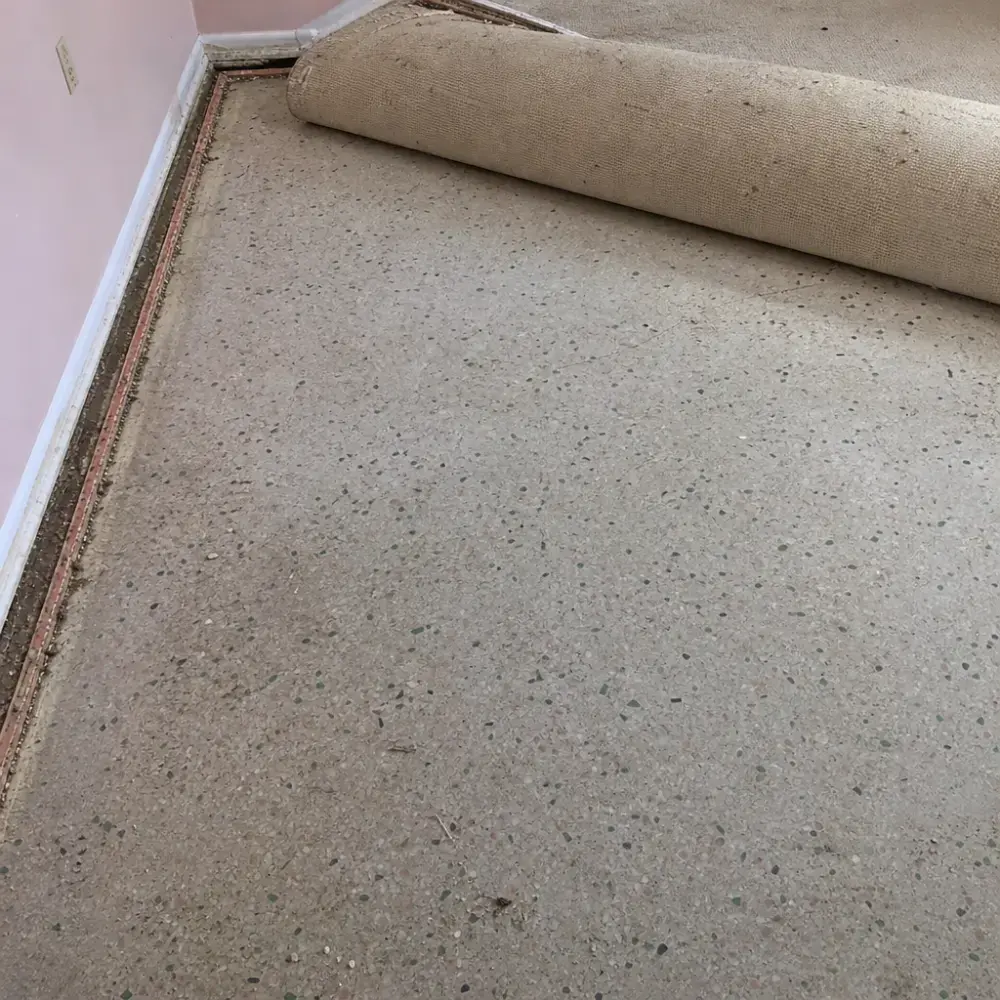
We grind, patch, polish, and seal the original cement terrazzo floors in Jacksonville’s postwar houses. Grinding and polishing runs $4 to $8 per square foot, taking up carpet and glue adds $2 to $3 per square foot, tile and thinset adds $4 to $5, and holes and cracks are $75 to $250 per patch. Send us a photo of a closet corner with the carpet folded back and the rough square footage, and we will tell you what the floor needs and roughly what it will cost before anyone comes out.
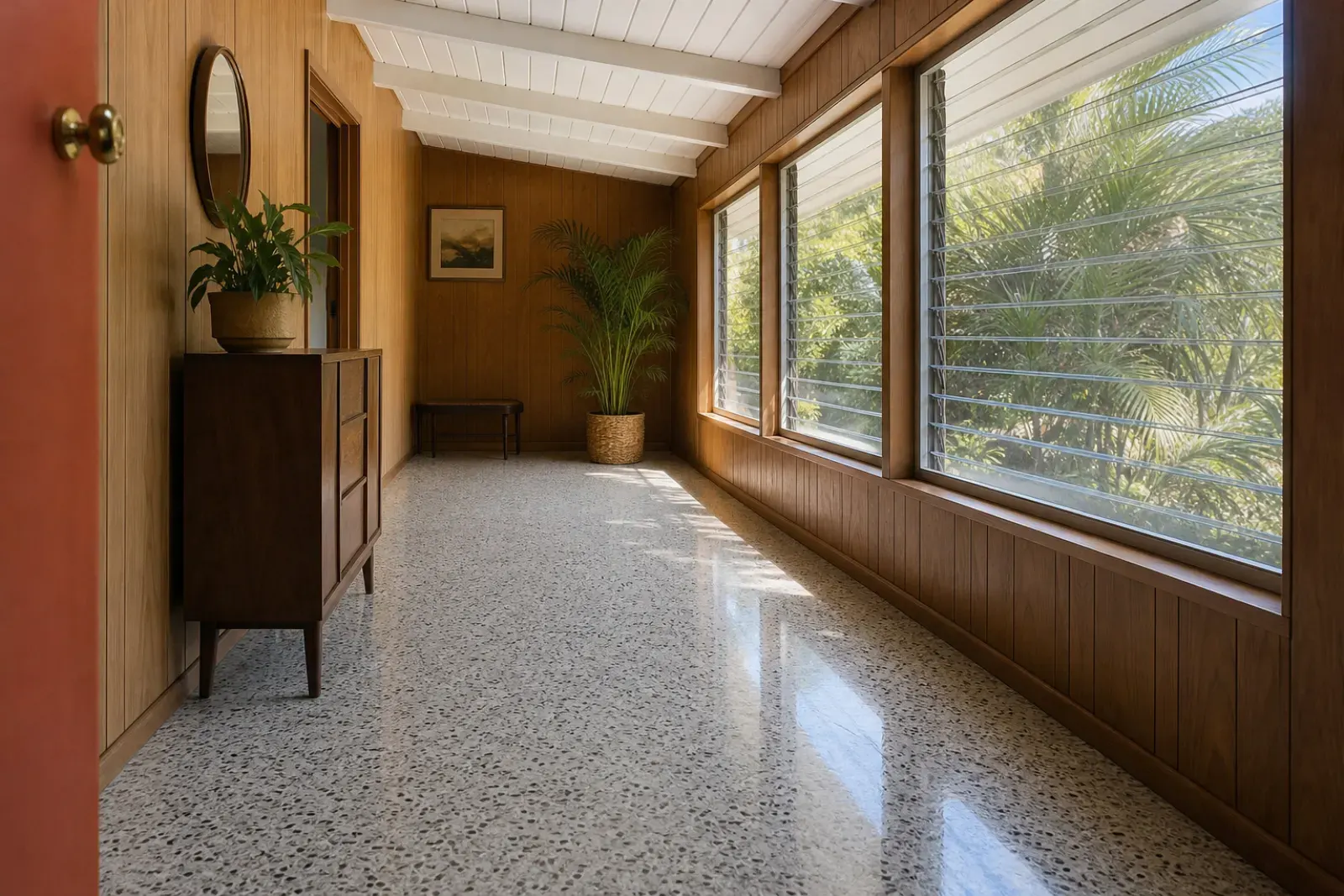
Terrazzo is one of the few floors in a sixty-year-old house that can be made to look better than the day it was poured. It is marble chips set in a Portland cement topping, ground flat and divided into panels by metal strips, and in a lot of Jacksonville houses it has spent decades under carpet, vinyl, or tile. Bringing it back is diamond grinding, not buffing, and the difference shows within a year: a ground and honed floor keeps its polish, and a floor that was mopped with a “restorer” coating goes cloudy.
What we do
- Terrazzo restoration: the full job on a covered or worn floor. Uncover, patch, grind, hone, polish, seal.
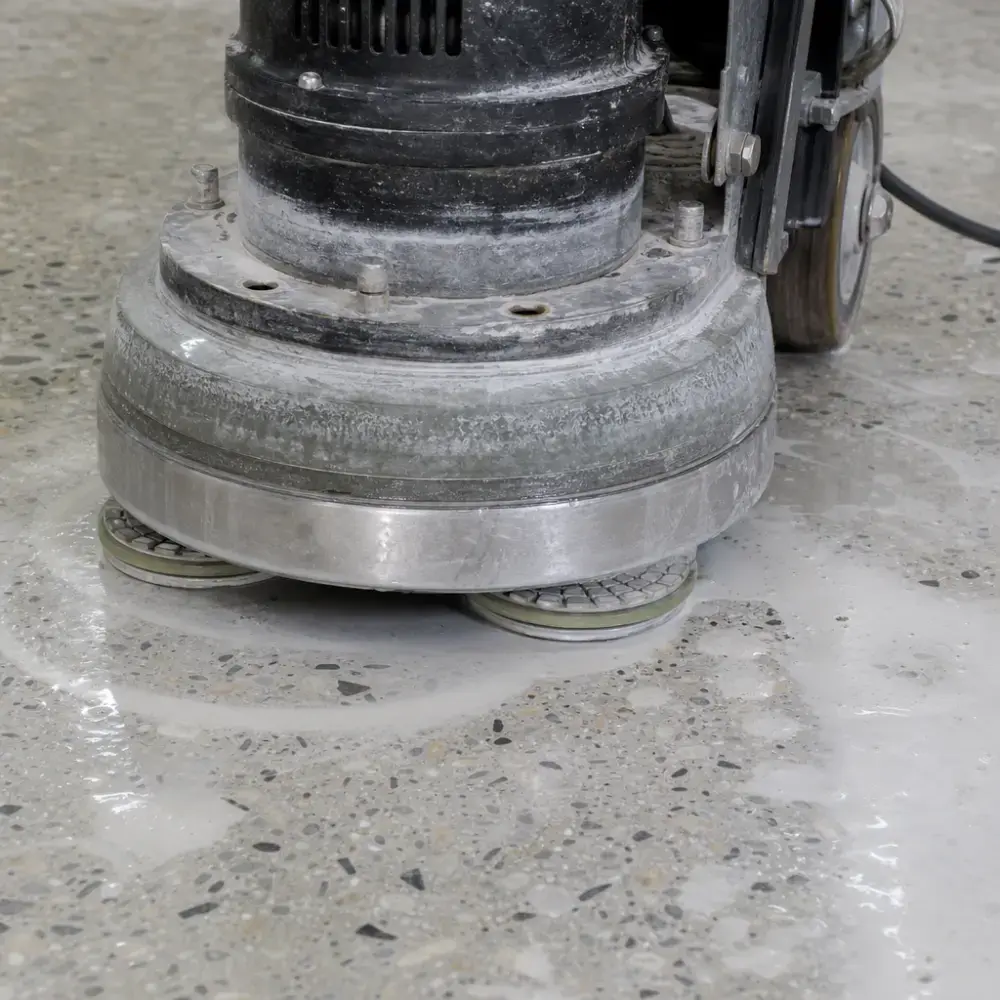
- Grinding and polishing: planetary grinders with metal-bond diamonds to flatten the floor and cut off glue and old coatings, then resin-bond diamonds to bring the shine up from the stone.
- Crack and hole repair: plumbing cores, trenches where a wall came out, cracks, and the rows of tack-strip nail holes along every carpeted wall.
- Carpet, tile, and glue removal: carpet, pad, tack strip, ceramic tile, thinset, and black adhesive off the terrazzo without gouging it.
- Stain and rust removal: rust rings, carpet-pad dye, pet urine, and oil, with an honest call on which ones will only fade.
- Sealing and maintenance: penetrating sealer on a restored floor and a cleaning routine that copes with sand and humidity.
- Flood-damaged terrazzo repair: drying checks, salt residue, hollow sections, and the grind after a river surge or tidal flood.
Why there is so much terrazzo under Jacksonville carpet
Duval County went from 304,029 people in 1950 to 455,411 in 1960 and 528,865 in 1970, according to the census table on the county’s Wikipedia page. That is roughly 225,000 new residents in twenty years, and most of them moved into single-story houses on new suburban streets. The University of Florida’s statewide survey of postwar housing, Florida’s Single Family Housing at Mid-Twentieth Century (1945-1975), quotes the trade magazine House and Home describing the typical Florida house as “built on slabs, terrazzo or resilient tile floors, cement tile roofs, prefabricated roof trusses,” with 99 percent of them concrete block. The same survey notes Florida housing starts jumped 77 percent from 1954 to 1958.
The Florida Department of Transportation’s style guide for postwar buildings explains the block: it was “especially prevalent in Florida during the post-World War II era due to its ability to withstand hurricanes, its energy efficiency, and affordability,” and it was often covered with a veneer of brick. That last detail matters here. A lot of Jacksonville ranches that look like brick houses from the street are block houses on a slab, and the slab is where terrazzo was poured.
Where the postwar houses are:
- Arlington. Wikipedia’s Arlington article says the area grew faster than any other part of Jacksonville for two decades after the Mathews Bridge opened in 1953. The UF survey documents Alderman Park there, 696 homes built mainly between 1955 and 1974, “many” of them concrete block finished in paint, stucco, siding, or brick veneer. More on the Arlington page.
- Cedar Hills. About 3,000 brick or concrete block homes built in the 1940s and 1950s in seven neighborhoods on the Westside, per a Metro Jacksonville history; the Jaxson magazine places the area along the Cedar River. See the Cedar Hills page.
- Lakewood and San Jose. Lakewood was started by Walter Crabtree in 1946 along San Jose Boulevard; San Jose was replatted after World War II and today mixes 1920s Mediterranean Revival houses with midcentury ranches. See Lakewood and San Jose.
- The Beaches. Jacksonville Beach went from 6,430 people in 1950 to 12,049 in 1960, and Atlantic Beach roughly doubled in each of the two decades after 1950, per the census tables on their Wikipedia pages. See Jacksonville Beach.
The honest part: not every house has it
Jacksonville is not South Florida. When we pulled Duval County Property Appraiser records for 1950s and 1960 houses in Cedar Hills, Lakewood, and Arlington, the interior flooring field read carpet, sheet vinyl, ceramic clay tile, parquet, and on a good number of them, hardwood. Several 1955 concrete block houses on Cedar Hills Boulevard, 1960 block houses on Rogero Road in Arlington, and 1949 to 1951 block-and-stucco houses on Lakewood’s college-named streets are recorded with hardwood floors. None of those records listed terrazzo. The field does have a terrazzo value and a few Duval houses carry it, but the record does not say whether a carpet or vinyl entry is the original floor or a covering, so it cannot rule terrazzo in or out.
So the record cannot tell you, and neither can the age of the house alone. The only reliable test is to look. Fold back carpet in a closet corner, pull a floor register, or look under a threshold strip. If you see marble chips in a gray, white, or tinted cement with a thin metal line running through it, you have terrazzo. If you see oak boards or a plain concrete slab, you do not, and we will tell you so. Our guide to reading a Duval property record walks through the clues in more detail.
What we usually find on these floors
- Carpet glue and pad residue, often black cutback adhesive, plus a tack strip around every room. Each tack nail leaves a hole and many leave a rust ring.
- Ceramic tile and thinset in kitchens, baths, and entries. The tile setter usually roughened the terrazzo so the mortar would bond, so a tiled area comes up pitted.
- Trenches and cores where walls were moved, drain lines were rerouted, or a bathroom was added.
- Old coatings of acrylic or urethane laid down to make the floor shine, now yellow and flaking.
- Salt and water marks in houses that took water in a storm. The St. Johns River at the Main Street Bridge reached 5.57 feet during Hurricane Irma in September 2017, breaking the 4.12-foot record set by Hurricane Dora in 1964.
- Dull traffic paths near doors, worst at the Beaches, where sand acts like sandpaper underfoot.
Every one of these has its own page under terrazzo problems, with a five-minute check and the price.
How a job runs
- Look first. We uncover a test area, check chip size and matrix color, tap the floor for hollow spots, and look for old coatings and moisture before we quote the grind.
- Take off the covering. Carpet, pad, tack strip, tile, and thinset come up. Adhesive is mostly left for the grinder, which removes it more cleanly than scrapers do.
- Patch. Holes and cracks are cleaned out and filled with marble chips matched to your floor in a tinted matrix. The NTMA restoration specification calls for aggregate in any crack fill wider than a quarter inch, and for a jagged, saw-tooth edge on a replaced section so the seam does not read as a straight line.
- Grind. Metal-bond diamonds flatten the floor and remove glue, stains, and the worn top layer. We grind wet or with vacuum shrouds to keep the dust down.
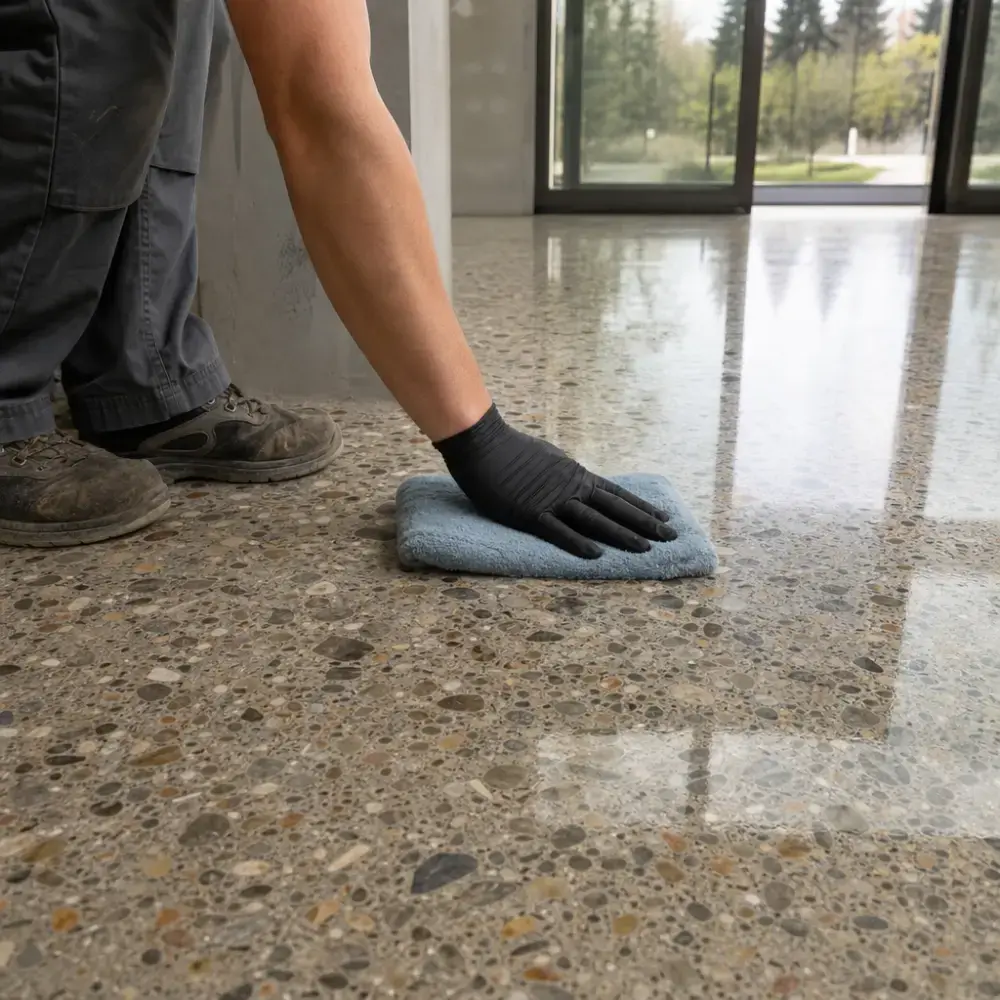
- Hone and polish. Resin-bond diamonds step up through the grits. Stop around 400 for a soft satin; keep going toward 1500 or 3000 for a high gloss.
- Seal. A penetrating sealer goes into the cement matrix. No wax, no film.
Typical prices
| Work | Typical range |
|---|---|
| Grinding and polishing | $4 to $8 per sq ft |
| Carpet, pad, and glue removal | $2 to $3 per sq ft extra |
| Tile and thinset removal | $4 to $5 per sq ft extra |
| Hole or crack patch | $75 to $250 each |
| Stain or rust treatment | $150 to $600 per area |
| Sealing a restored floor | $1 to $2 per sq ft |
| One-room minimum, or repair-visit setup | $600 to $1,000 |
These are in line with published national cost guides: HomeGuide puts terrazzo restoration at $3 to $8 per square foot on average, with a full range of $1 to $20, and Angi lists terrazzo at $8 to $18 per square foot among stone restoration jobs. The pricing page explains what puts a Jacksonville floor at the low or high end, and the cost calculator works out your number from four or five answers.
About licenses
Florida does not license terrazzo restoration as its own trade. Section 489.117(4)(a) of the Florida Statutes says a local government may not require a license for job scopes including flooring and “decorative stone, tile, marble, granite, or terrazzo installation.” So there is no terrazzo license number for anyone to show you. What you should ask any company for, including us, is a certificate of insurance before work starts, and a written scope that lists which stains and patches will be visible afterward. More on that on the about page.
Getting a quote
Send three things through the form: a photo of a corner with the carpet pulled back, a close-up of the worst spot with a coin in the frame, and the approximate square footage. If you know the house took water in Irma, Nicole, or a nor’easter tide, say so. You will get a range from the table above and a plain answer about what will grind out and what will not. Common questions are on the FAQ.