 Jacksonville Terrazzo Restoration
Terrazzo Crack and Hole Repair in Jacksonville
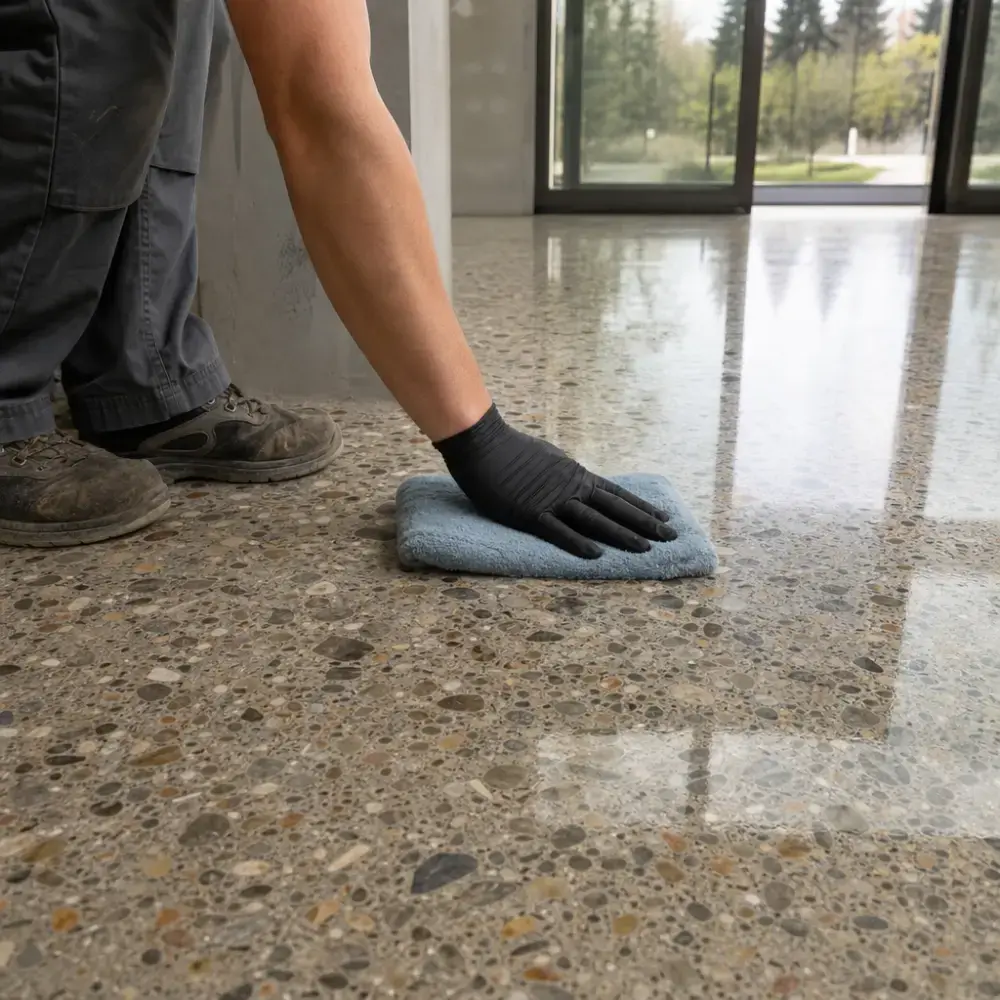
Terrazzo crack and hole repair in Jacksonville costs $75 to $250 per patch. We clean each hole or crack back to sound material, fill it with marble chips matched to your floor in a cement or epoxy matrix tinted to the original, let it cure, and grind it flush. The rows of tack-strip nail holes in a carpeted room are priced by the room, and a repair-only visit starts with a $600 to $1,000 setup charge. A photo with a coin next to the damage is usually enough for a number.
Repair always comes before grinding. A patch has to be hard before a diamond touches it, and patches ground together with the rest of the floor blend in far better than patches ground on their own. That is why most repairs we do are part of a full restoration.
Damage we fill on Jacksonville floors
- Plumbing cores. Round holes where a drain or supply line came up through the slab and was later moved. Common in kitchens and baths remodeled after the 1970s.
- Wall trenches. A strip of bare slab, a few inches wide, where a partition wall was removed to open up a living room or kitchen. Terrazzo was poured around walls, not under them.
- Tack-strip holes. Hundreds per room, every few inches along every wall that was carpeted. Most are shallow and grind out; the deeper ones get filled in the grout pass.
- Post and anchor holes. From carport posts in houses where the carport became a room, screen porch frames, and old bolt-down fixtures.
- Chips at doorways. Where tile was chiseled off, a threshold was pried up, or a heavy appliance was dragged.
- Cracks. Fine shrinkage cracks from the original cure, cracks where a strip is missing, and cracks that track movement in the slab below.
- Bent or missing divider strips. Cut out for a trench or folded over by a tile crew.
How a patch is built
- Map it with you. The NTMA’s restoration specification has the owner and contractor walk the whole floor together and agree on each crack: no action, repair the crack, or replace that section of terrazzo. We do the same walk, with tape on the floor.
- Cut back. Loose and crumbling material comes out. A section being replaced is cut out from divider strip to divider strip where possible. Where it is not, the NTMA specification calls for the joining edge to be saw-toothed, jagged rather than straight, because the eye finds a straight seam instantly.
- Fix the concrete underneath. If the slab itself is cracked, it gets filled first. The NTMA specification uses a hardening epoxy for cracks in the concrete substrate.
- Fill. Marble chips matched to the floor in a matrix tinted to match. Small holes and cracks usually get epoxy because it cures quickly and grips old cement; a large replaced section can be cement or epoxy terrazzo.
- Cure, then grind with the floor. The patch hardens, then it is ground and polished in the same passes as everything around it.
Cracks: two kinds, two answers
The NTMA specification classifies hairline cracks as less than 1/32 inch and calls for cracks to be cleaned and filled with resin matched to the existing floor, with aggregate added in any crack wider than a quarter inch so the fill reads as terrazzo and not as a solid line of color.
The real question is whether the crack is still moving. Divider strips exist to control cracking: the NTMA’s history of the strip quotes Louis Del Turco’s 1921 patent describing metal dividers that “prevent or at least localize cracks,” and notes that cement terrazzo standards still call for strips on a four-foot by four-foot grid. A crack that runs between strips, in a floor whose strips are farther apart than that, is usually a shrinkage crack from the pour, and it fills well. A crack that wanders diagonally through strips and lines up with a crack in a block wall is following the slab, and it may open again. We tell you which kind you have before we fill it.
Divider strips
The NTMA’s strip history says early strips were usually brass, with copper or zinc used for looks, and that many were made in two pieces: a brass or zinc top on a galvanized steel base. When a strip is bent, we straighten or reset it. When one is missing, we replace it with the same metal so it brightens to the same color as its neighbors under the diamonds. More on strip metals on the divider strips reference page.
How visible will it be?
Honest answer: invisible from standing height in most light, findable when you kneel. The NTMA’s restoration specification says color matching existing aggregate may not be exact because marble is a mined product that can change over time, and it recommends a mock-up so everyone agrees on expectations. We do one sample patch, you approve it, then we do the rest.
For a big trench where a wall came out, consider making it a feature: a contrasting band, or a new panel with fresh strips. It is a legitimate design choice and it avoids a near-miss match across several feet of floor.
Pricing
| Repair | Typical range |
|---|---|
| Plumbing core, small chip, anchor hole | $75 to $150 |
| Crack cut back to a strip, panel section, strip reset | $150 to $250 per patch |
| Wall trench | $150 to $250 per patch, long trenches count as more than one |
| Tack-strip holes in a carpeted room | Quoted per room |
| Repair-only visit setup | $600 to $1,000 |
Patches done during a full restoration cost less overall, because the grinder is already there and the patches are ground with the floor. The patch and repair estimator adds up a repair-only visit, and the pricing page has the full table.
Related problems
If you are looking at a specific kind of damage, these pages go deeper: cracked terrazzo, a gap where a wall was removed, tack-strip holes and rust rings, and hollow-sounding spots.
Frequently Asked Questions
What does a terrazzo patch cost?
$75 to $250 per patch. A round plumbing core or a chipped spot at a doorway sits near the bottom. A crack that has to be cut back to a divider strip, or a trench where a wall was removed, sits near the top, and a long trench can count as two or three patches. A repair-only visit starts with a $600 to $1,000 setup charge, so batch everything into one trip.
How do you match the chips?
By color, by size, and by the tint of the cement around them. We look at the floor up close, pick marble chips that match the blend, and tint the matrix to the original, whether that is gray, white, or a color. A loose piece of the old floor from a closet or a cut-out helps a lot. We do one sample patch for your approval first.
Will the crack come back?
A crack that formed when the floor shrank during its first cure, decades ago, usually stays filled. A crack that keeps moving with the slab can reopen, and filling it rigid will not stop that. If a crack runs straight through divider strips and lines up with a crack in the wall, we will tell you it is a slab movement crack and talk about a flexible fill.
Can you fill a gap where a wall used to be?
Yes. When a partition wall comes out of a midcentury house, it leaves a strip of bare slab where no terrazzo was ever poured. We fill it with matched chips in a tinted matrix, set divider strips if the panel layout calls for them, and grind it with the rest of the floor. Some owners make it a contrasting band on purpose, which often looks better than a near match.
More terrazzo services
Areas we serve
- Jacksonville, FL
- Terrazzo Restoration in Arlington, Jacksonville
- Terrazzo Restoration in Atlantic Beach
- Terrazzo Restoration in Cedar Hills, Jacksonville
- Terrazzo Restoration in Englewood, Jacksonville
- Terrazzo Restoration in Jacksonville Beach
- Terrazzo Restoration in Lakewood, Jacksonville
- Terrazzo Restoration in Neptune Beach
- Terrazzo Restoration in Orange Park
- Terrazzo Restoration in San Jose, Jacksonville