 Jacksonville Terrazzo Restoration
Terrazzo Floor Restoration in Jacksonville
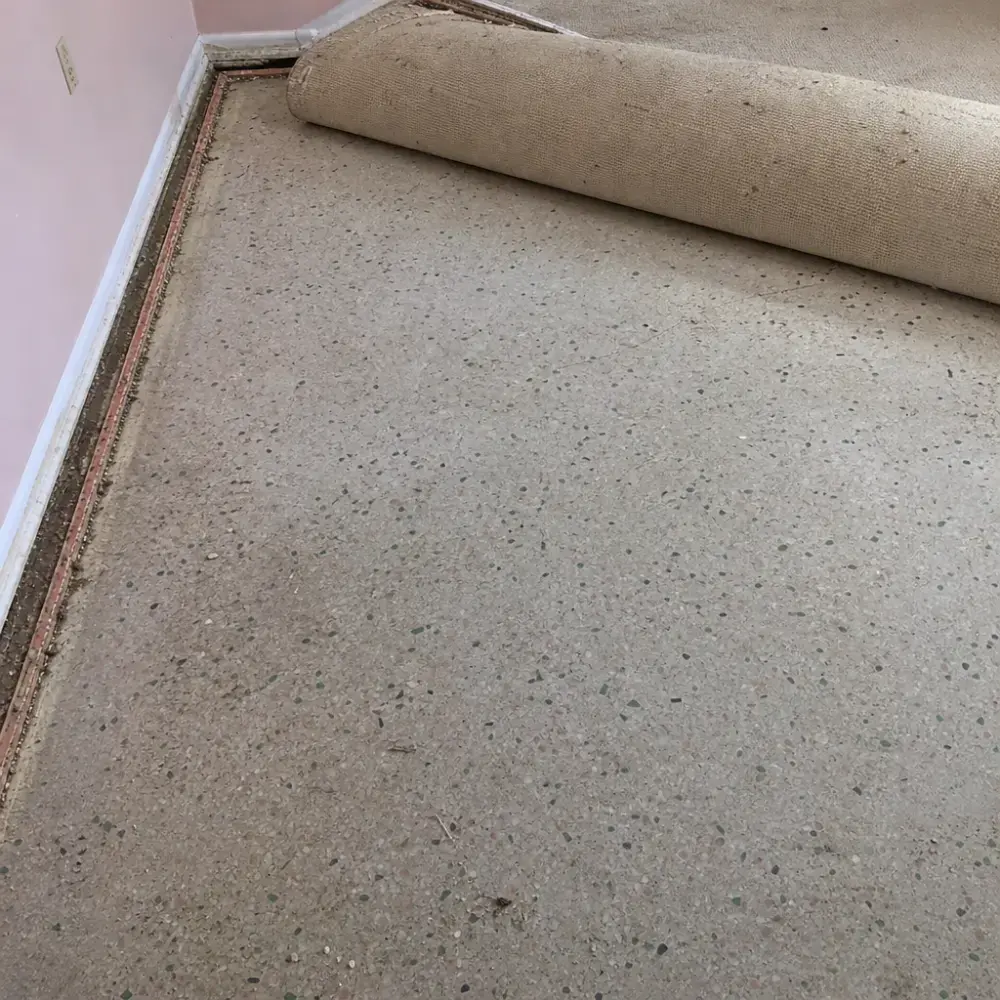
Full terrazzo restoration in Jacksonville runs $4 to $8 per square foot for the grinding, polishing, and sealer, plus whatever has to come off the floor first: $2 to $3 per square foot for carpet and glue, $4 to $5 for tile and thinset, and $75 to $250 per patch for holes and cracks. It is the right service for a floor that has been covered or neglected for decades, and it is what most of the floors in Arlington, Cedar Hills, and Lakewood need when the carpet comes up.
Restoration is the whole sequence, start to finish, done by one crew in one order. The order matters more than people think. Patching before grinding, grinding before polishing, and drying before sealing are the three rules that separate a floor that lasts from one that clouds over in a year.
Who this is for
- You pulled up carpet and found speckled stone with metal strips, glue, and nail holes.
- You bought a 1950s or 1960s block house and want the original floor back before you move in.
- A room was gutted after water came in and the terrazzo is now bare, stained, and dull.
- Somebody coated the floor years ago and it is now yellow and peeling.
If your floor is already exposed, flat, and only dull, the lighter grinding and polishing service may be all it needs. If it only needs a few holes filled, the crack and hole repair page covers that visit.
The sequence, step by step
1. Look before quoting the grind
We uncover a test area, usually a closet or the edge of a room, and look at four things. Chip size and color, because big chips need more grinding passes than small ones. The matrix color, gray, white, or tinted, because patches have to match it. Old coatings, because a urethane or acrylic film has to be cut off before the stone. And soundness, by dragging a steel ball or a tool handle across the floor and listening for a dull, hollow note where the topping has let go of the slab.
2. Take off what is on top
Carpet, pad, and tack strip come up. Ceramic tile is broken out and the thinset chipped down. Most adhesive is left on the floor for the grinder, because metal-bond diamonds take it off more evenly than scrapers. One exception: if the adhesive is black and the house dates to the period when asbestos was used in flooring products, it gets tested before anybody grinds it. EPA lists adhesives among household materials that may contain asbestos and says sampling should be done by a trained and accredited asbestos professional. See the black carpet glue page.
3. Patch
Holes, cracks, and trenches are cleaned out to sound material and filled with marble chips matched to your floor in a tinted matrix. The NTMA’s restoration specification asks the owner and contractor to walk the floor together and agree, crack by crack, whether to leave it, repair it, or replace that section, and it calls for a saw-tooth edge on any replaced section that does not end at a divider strip. Patches cure before grinding. The crack and hole repair page has the details.
4. Grind
Planetary grinders with metal-bond diamonds flatten the floor, remove glue and coatings, and cut off the worn and stained top layer. Rust rings from tack nails and dye from carpet pad usually disappear in these passes. We grind wet, or dry with a vacuum shroud and a dust collector, and edges along walls are done with smaller hand grinders.
5. Grout and hone
After the coarse grind, the floor is washed and the small pinholes it exposed are filled with a cement or epoxy grout that matches the matrix. The NTMA specification calls for at least 12 hours of grout cure at 70 to 80 degrees. Then resin-bond diamonds step up through finer grits to remove the grout film and refine the surface.
6. Polish to the sheen you pick
Satin stops around 400 grit and hides scratches well, which is why we suggest it near the beach. Higher grits, up to 1500 or 3000, bring a deeper gloss that looks wet in the light and shows grit sooner. The shine comes from the stone, not from anything applied on top.
7. Seal
A penetrating sealer soaks into the cement matrix to slow stains from spills. No wax, no film. You get written care instructions with a neutral pH cleaner, because the NTMA care guide warns against vinegar, bleach, ammonia, and degreasers on terrazzo.
What it costs
| Line | Typical range |
|---|---|
| Grind, hone, polish, penetrating sealer | $4 to $8 per sq ft |
| Carpet, pad, tack strip, glue | $2 to $3 per sq ft extra |
| Tile and thinset | $4 to $5 per sq ft extra |
| Patches | $75 to $250 each |
| Stains that survive the grind | $150 to $600 per area |
| High gloss (1500 grit and up) | About 15 percent more on the grind |
| Minimum, one room | $600 to $1,000 |
A 1,000 square foot floor under carpet with five patches works out between about $6,400 and $12,300 at these rates. The pricing page has three full examples and the cost calculator builds one from your answers.
How long it takes and what it is like to live through
A whole house usually takes several working days. The first day is mostly removal. Patching needs cure time. The grinding and polishing passes move room by room, and each room is sealed and walkable before the crew moves on, so you can stay in the house if you can live around the active room. Furniture moves with us. An empty house is faster and cheaper.
Dust is lower than most people expect. OSHA’s silica rule for floor grinders requires continuous water at the cutting surface or a dust collector with a 99 percent efficient filter, plus HEPA vacuuming between passes indoors, and that is how the work should be done in a lived-in house. Ask which method any bidder uses.
What restoration cannot fix
Some stains go deep. The NTMA’s restoration specification states that all staining in existing terrazzo may not be possible to remove, and pet urine that soaked into the cement for twenty years is the usual example. Patches blend from standing height and show up close. A section that has lost its bond can be replaced, but it is new terrazzo next to old. We point out each of these on the walk-through and write them into the scope.
Jacksonville specifics
Two things come up here more than elsewhere. First, river and tidal flooding: houses near the St. Johns took water in Hurricane Irma in 2017, when the river at the Main Street Bridge reached a record 5.57 feet, and a slab that has flooded needs to dry and be checked for salt before it is sealed. The flood-damaged terrazzo page covers that. Second, not every 1950s house here has terrazzo. Duval property records for the period show plenty of hardwood, so look in a closet before you plan the budget. Our property records guide explains what the record can and cannot tell you.
Send a closet-corner photo, a close-up with a coin, and the square footage, and we will reply with a range from the table above.
Frequently Asked Questions
What is included in a full terrazzo restoration?
Taking the covering off, patching holes and cracks with matched marble chips, grinding with metal-bond diamonds, honing and polishing with resin-bond diamonds, and a penetrating sealer. The grind, polish, and sealer are $4 to $8 per square foot. Removal is $2 to $3 per square foot for carpet and glue or $4 to $5 for tile, and patches are $75 to $250 each.
How is restoration different from just polishing?
Polishing alone suits a floor that is already exposed, flat, and sound. Restoration is for a floor that has been covered, glued, coated, or damaged, where the first passes have to cut through adhesive and the worn top layer before polishing even starts. Most Jacksonville floors that have been under carpet since the 1970s or 1980s need the full restoration.
What if my floor turns out to be in bad shape under the carpet?
Most bad-looking floors are fine underneath the glue. What changes the plan is a large hollow area that has lost its bond to the slab, a topping that someone already ground thin, or a big section cut out for plumbing. We find those during the first visit by uncovering a test area and tapping the floor, and the written quote reflects what we found.
Can you restore just one room?
Yes, with a $600 to $1,000 minimum, because the grinders and setup cost the same for one room as for five. The catch is that a single restored room next to unrestored terrazzo shows the difference clearly at the doorway. If the rest of the house will be done eventually, doing it all at once costs less per square foot.
More terrazzo services
Areas we serve
- Jacksonville, FL
- Terrazzo Restoration in Arlington, Jacksonville
- Terrazzo Restoration in Atlantic Beach
- Terrazzo Restoration in Cedar Hills, Jacksonville
- Terrazzo Restoration in Englewood, Jacksonville
- Terrazzo Restoration in Jacksonville Beach
- Terrazzo Restoration in Lakewood, Jacksonville
- Terrazzo Restoration in Neptune Beach
- Terrazzo Restoration in Orange Park
- Terrazzo Restoration in San Jose, Jacksonville